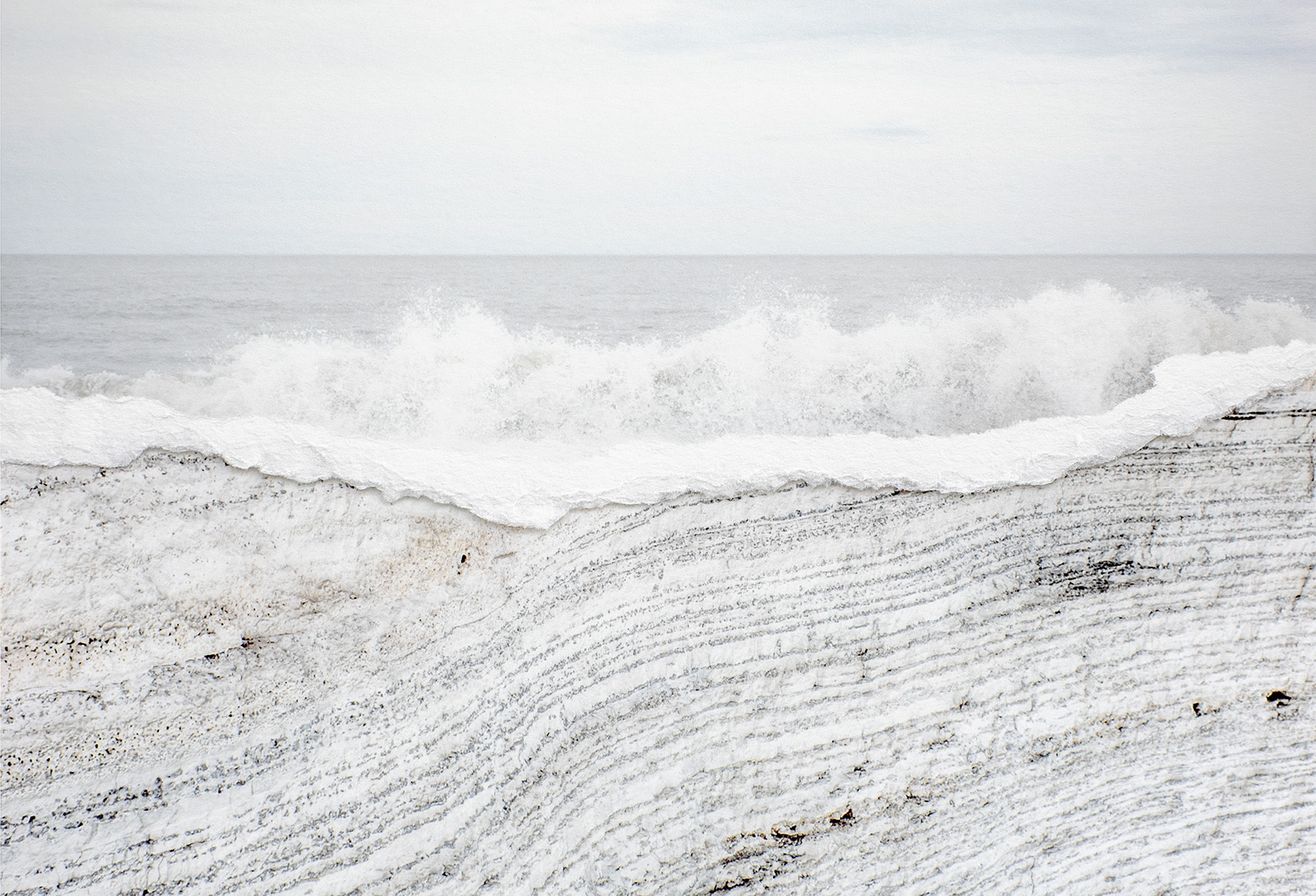
Marilia Destot, Sédimentations de la série Memoryscapes, 2025 © Courtesy galerie Sit Down.
EN⭢ FR
June 5 - July 5, 2026
Opening days on June 5-6-7
In 2026, the 7th edition of the BPM - Biennale de la Photographie de Mulhouse invites to explore geological and mental geographies, drawing on the notions of sedimentation, matter-flux, and the plasticity of collective and individual memories.
This theme is linked to the location of the city of Mulhouse in Alsace, where the festival is taking place. 33 million years ago, the Alsace plain was a seabed. The sea deposited thick layers of limestone and marl what now is Mulhouse. This perpetual action of combined flux and sediment, this animate geological organism, propagates a living collective, cultural history of a region and its inhabitants in its topographical expression, as a backdrop to innumerable lives. Its inhabitants excavate it for shelter, mineral resources, and to explore their own histories and narratives over the millennia.
In the same way as these sedimentation phenomena, the BPM's 2026 edition brings together photographers who explore the past, interested in excavations both geological and memorial. Mining, excavating, and digging serve as methodologies of investigation, enabling the exploration of both Earth and mind. The exhibitions intertwine individual and collective stories, both human and non-human.
Through 12 exhibitions, the 2026 BPM presents the works of :
Gaëlle Delort, Marilia Destot, Rıfat Göbelez, Bernard Guillot, Pauline Hisbacq, Sangyon Joo, Eugenie Shinkle, Roselyne Titaud, Jenia Fridlyand, Sue-Elie Andrade Dé, Elsa Beaumont, Marjolein Blom, Sarah Braeck, Ella Bryant, Yuki Furusawa, Chiara Goia, Jess Gough, Susann Carmen Jagodzinska, Zach Knott, Ruth Lauer Manenti, Artur Leão, Jessica Lennan, Sergio Lovati, Anne Mocaër, Yvette Monahan, Fernande Petitdemange, Julie Rochereau, Angela Tozzi, Ali Uchida, Alyssa Warren, Theo Zeal, Mahmoud Alhaj, Adji Dieye, Jennifer Douzenel, Eric Gyamfi, Kapwani Kiwanga, George Mahashe, Otobong Nkanga, Leonard Pongo, Tiago Casanova, Rebecca Bowring, Eleonora Calvelli, François Jonquet, Katya Lesiv, Natalie Malisse, Ulf Lundin, Margot Wallard, Jean-Claude Figenwald, Pablo Castilla, Manuela Marques, Sandra Eades, Gisoo Kim, Lilly Lulay, Dalmonia Rognean, Wenke Seemann
and that of students of the Grand Est Region's Art Schools who are taking photography classes with Constance Nouvel, Estefania Penafiel-Loaiza, Delphine Gatinois, Andrea Keen, Laurent Montaron, Anne Immelé, Isabelle Le Minh
“The 12 exhibitions in this edition offer different approaches to the phenomena of sedimentation. Since its invention, photography has been doubly linked to these processes: not only because it sources its own chemistry from minerals, but also because photography, memory, and archives operate according to a logic of stratification.
Sedimentation is not static; it is a dynamic phenomenon in a state of constant transformation. The exhibitions in this edition were conceived in the same way, designed as an active, effervescent medium. Sedimentation is an active phase; stratification is its result. In the same way, photography facilitates this transition. Hiroshi Sugimoto noted that ‘taking a photograph is fossilizing the present.’
Stories of rocks, multiple timeframes
Rocks, caves, cliffs, and various geological formations have inspired photographers since the invention of photography. They also allow contemporary photographers to explore different materialities and installations.
The exhibition Sedimentation(s) – A Constellation (Museum of Fine Arts) takes as its starting point a fascination with the mineral world. It will be an evolving exhibition: photographs from the Nicéphore Niépce Museum will gradually be incorporated into the display throughout the exhibition. Eugenie Shinkle and Marilia Destot develop images that measure up to geological time to create fragmented works, whose
creation process proceeds through layers of memory and vision. Through a documentary approach to natural cavities, Gaëlle Delort explores the depths of the world.
In this vein, Pablo Castilla (Parks on the Banks of the Ill) explores the connections between human and geological timeframes. By creating images imbued with telluric forces, Manuela Marques (French Cultural Center Freiburg) forges a unique relationship with the places she photographs, bringing to light various layers of perception and creating a dialogue between historical, geographical, and scientific data.
From the cliffs of the English coast to marble quarries, through a variety of approaches, the PEP exhibition (Grand’Rue Library) presents a strong geological dimension in the photographs of Jessica Lennan, Zach Knott, Fernande Petitdemange, Artur Leão, Jess Gough, Chiara Goia, Sergio Lovati, and Angela Tozzi. Meanwhile, Yvette Monahan and Sarah Braeck explore submerged geologies beneath the catalyst of sedimentation that is the ocean.
Buried memories & materialities
Several exhibitions explore individual and collective memories—buried and sometimes forgotten. The photographic series by Rebecca Bowring, Eleonora Calvelli, François Jonquet, Katya Lesiv, Ulf Lundin, Natalie Malisse and Margot Wallard, brought together in the exhibition Bruissements (Whispers) (Europe Tower), are rooted in the domestic space, surfacing relationships and memories from the family often transparent to the naked eye. These themes are also explored in the PEP exhibition (Grand’Rue Library). Among the 22 photographers featured, the photographs by Sue-Élie Andrade-De, Yuki Furusawa, Susann Carmen Jagodzińska and Ruth Lauer Manenti explore intergenerational family ties, often encompassing deep-seated joy & turmoil that carries through the human body. Personal memories—whether of family, friends, or specific places—are sometimes preserved from oblivion through photography, as is the case in the very different photographic approaches of Alyssa Warren, Theo Zeal, Ella Bryant, Elsa Beaumont, Anne Mocaër, Ali Uchida, Julie Rochereau, and Marjolein Blom.
Bringing together Adji Dieye, Jennifer Douzenel, Eric Gyamfi, Kapwani Kiwanga, George Mahashe, Otobong Nkanga, and Léonard Pongo, the exhibition Settled (La Filature) revisits the archival framework in light of history but also its gaps, exploring the modes of visibility and invisibility that permeate our era. Adji Dieye’s installation blends personal archives from contemporary Senegal with national archives from the colonial era. Otobong Nkanga’s installation Taste of Stone functions as a series of stories of bodies and sensations centered around a stone. The emphasis on the materiality of images and slow modes of production is also evident in the exhibition Sediments of Memory (Morat-Hallen), which brings together works by Sandra Eades, Gisoo Kim, Lilly Lulay, Dalmonia Rognean, and Wenke Seemann. Like Lilly Lulay, these artists transform photographs using needles and thread, scissors, and glue, and combine them with other images.
By creating a constellation of images, Sangyon Joo (Museum of Fine Arts) invites viewers to navigate their personal memory, moving through fragmented perceptions and natural landscapes. Through a keen observation of domestic and public spaces, Roselyne Titaud (Museum of Fine Arts and Europe Tower) reveals everyday objects—sometimes passed down from generation to generation—as well as the intertwining of forms, stories, and reconfigurations.
Civilizations, mediterranean histories, and beyond…
Several exhibitions explore issues related to territory and civilization. Drawing on the myth of Medusa, Tiago Casanova (Saint-Jean Chapel) weaves together stories of the contemporary Mediterranean, while Bernard Guillot, Pauline Hisbacq, and Rıfat Göbelez (Museum of Fine Arts) ground their photographic narratives in a dialogue with Mediterranean antiquity. By photographing rock fragments from the European and African continents, then folding the images to bring them together, Kapwani Kiwanga (La Filature) offers a reflection on deep time, migration, and territorial transformations.
For her first exhibition in France, Jenia Fridlyand (Museum of Fine Arts) has immersed herself in the inherently unpredictable environment of the island of Cuba. Her exhibition Limits of Control explores an aesthetic of sedimentation, rooted in the very fabric of a chaotic reality steeped in history.
A retrospective traces 50 years of Jean-Claude Figenwald’s career as a photojournalist (Le Séchoir). The exhibition interweaves different scales: that of the street where the photographer lives in Paris and that of the various countries and continents he has traversed, with his sequences punctuated by the major political events of recent decades.
Finally, the public spaces of Mulhouse showcase diverse visions of students from the art schools from the Grand Est region and Studio Images – Phnom Penh. Among these emerging practices, the exploration of photography’s origins has been highlighted through the use of film photography and reimagined traditional techniques.
The opening days on June 5, 6, and 7 will offer the opportunity to discover these 12 exhibitions in the presence of the photographers and curators, and to share approaches to contemporary photography.
Another medium for photography—The photobook - a powerful vehicle for the weaving of memories - is also in the spotlight during this opening weekend, through discussions and a photo book fair at the Museum of Fine Arts.
A big thank you to the artists, guest curators and publishers, and our partner venues and teams.
I wish you all a wonderful 2026 edition.”
Anne Immelé, artistic director