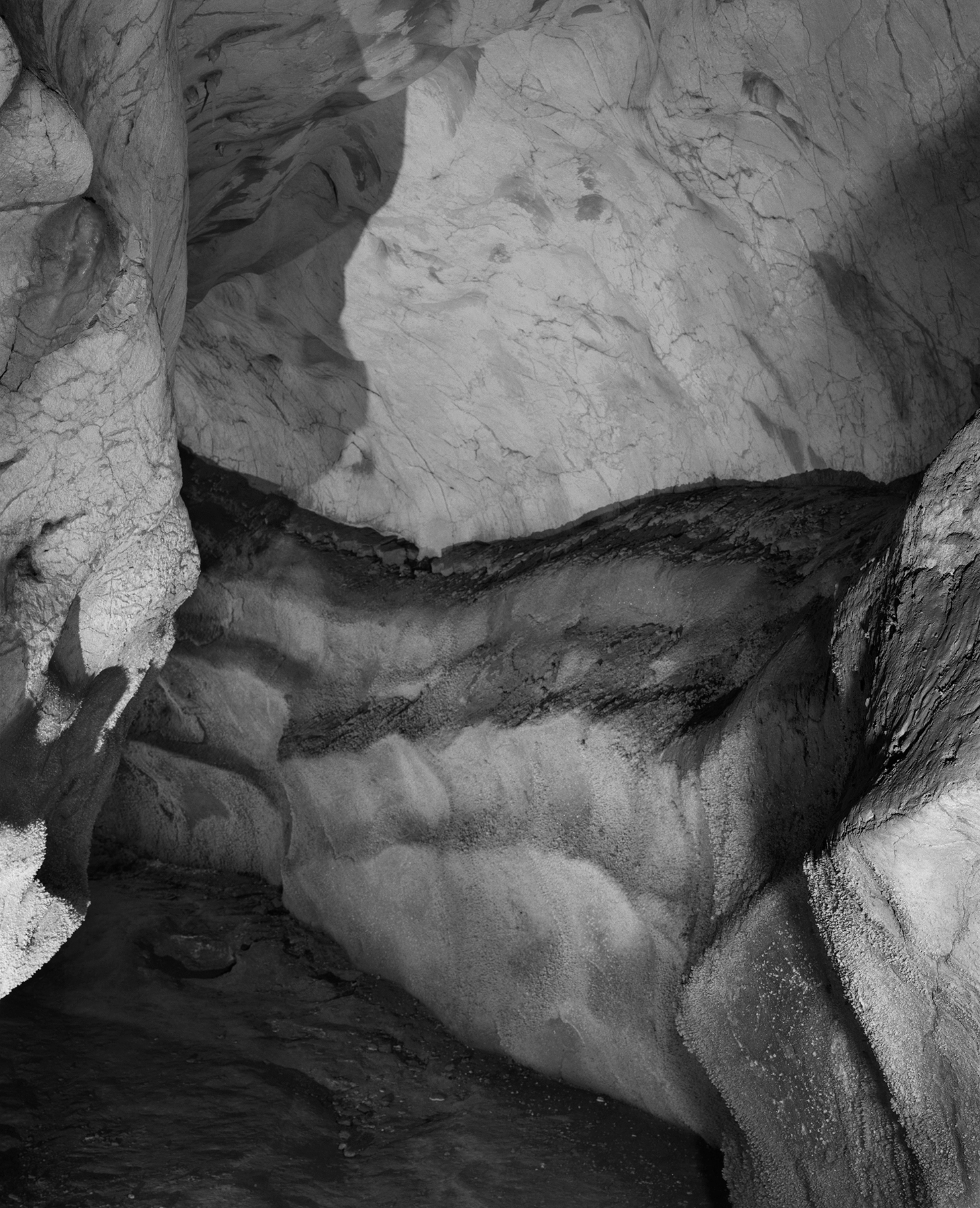
Gaëlle Delort, Grotte de Décamagne, Sainte-Anastasie, Gard, 2024 de la série Développements, 2024
EN ⭢ FR
Fine Arts Museum, Mulhouse
June 5 - September 20
Every day (except Tuesday and public holidays) from 10 a.m. to 1 p.m. and from 2 p.m. to 6 p.m.
Opening on Friday June 5 at 6:30 p.m.
Guided tour by Anne Immelé Sunday June 28 at 4p.m.
Curator : Anne Immelé
The concept of sedimentation serves to describe both natural geological processes and the strata of human thought. Drawing on this multifaceted meaning, the exhibition Sedimentation(s) – A constellation presents itself as a living, evolving entity that brings together different periods of photography. Spanning four time periods and spaces, the exhibition’s constellation connects photographs from the 19th century and the first half of the 20th century with contemporary images, as well as vernacular photographs with those taken by artists exploring the materiality of the image. The exhibition intertwines different memories: those of places, those of the photographer who lived in or traveled through these territories, and geological memory. The exhibition’s layout facilitates transitions from natural forms to man-made ones, amplifying the resonances between these worlds. Rocks, stones, their various states, and the ways in which they have shaped the landscape and been utilized across different civilizations are all central themes of the exhibition. Throughout its run, the exhibition will evolve. Over the weeks, additional images will be added to the established photographs, creating new layers of interpretation.
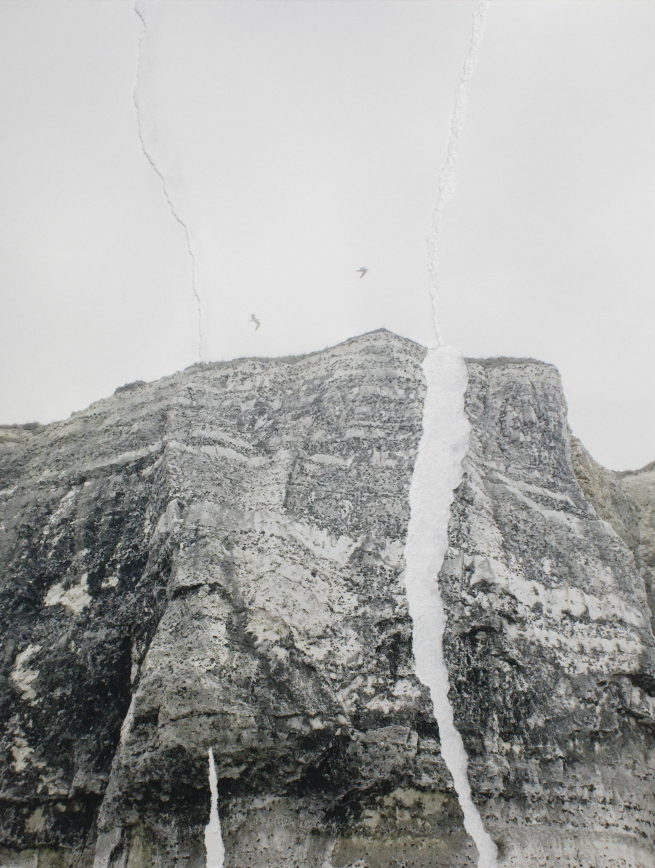
Marilia Destot, Falaise de la série Memoryscapes, 2023
In photography, “development” refers to the process of transforming a latent image into a visible image. In speleology, “development” refers to the cumulative length of the interconnected passages that make up an underground network.
Through the exploration of a dozen natural caves in the Occitanie region using a film-based view camera, and drawing on the perspectives and tools of geomorphologists, geologists, hydrogeologists, and geoarchaeologists, Développements invites us to consider underground environments as infinite laboratories of vision, which continue to reveal the archives of Earth’s history and its inhabitants.
The Développements series received support from the Occitanie Region through the 2025 Production Grant and the Residency 1+2.
Gaëlle Delort is a photographer who graduated from the École Nationale Supérieure de la Photographie in Arles. She lives in Lozère. By gathering the clues that give a place and its landscapes their depth, she seeks to capture the resonances between human and geological time, playing with the depth of the world and the surface of the images. Her work has been exhibited in France and abroad, notably at the Rencontres d’Arles, the Photosa Photography Biennial in Burkina Faso, the Ville Blanche in Marseille, the PhotoSaintGermain festival in Paris, and the Carte Blanche gallery in Hangzhou, China. Since 2020, she has been working on the project Karst, inspired by the geomorphology of the Grands Causses region, for which she received support from the DRAC Occitanie in 2023. In 2024, she produced the series Développements. Published by Filigranes, this work explores the materiality and temporality of film photography through the lens of subterranean environments, drawing on the visual frameworks of geomorphologists, geologists, and paleoclimatologists. She continues her research by combining her photographic practice with that of caving.
In the Memoryscapes series, Marilia Destot revisits her personal photographic archives and breathes new life into dormant images she has captured over the course of her travels and through the years. In her studio, the artist transforms this material: she prints the photographs, fragments them, tears them, overlays them, and assembles them into organic layers. Mysterious seascapes, mountain peaks, and undefined horizons are reassembled by hand. By playing with patterns, color palettes, shapes, and the folds of the tears, she experiments intuitively and spontaneously with these minimalist, abstract fragments. This gives rise to layers of space and time, strata of memory. The artist transforms organic landscapes into imagined ones, much like storytellers who draw on their memories to weave new tales. Guided by intuition and chance, she creates a collection of poetic images that interrogates and sketches a memory of the landscape as much as the landscapes of her memory.
The second part of the Memoryscapes series was developed during a residency at the Planches Contact festival in 2025.
Born in Grenoble, Marilia Destot is a French-American photographer based in New York. Her personal photography explores traces, the passage of time, and a poetic expression of family memory, landscapes traversed, and the body in motion. Her loved ones and nature inspire her; they serve as the models, mediums, and subjects of her intimate photographic narratives, developed over the long term. Her artistic practice involves fragmentation and repetition, the use of personal archives, and the manual alteration of photographic prints, such as stippling and collage. Her work explores the ephemeral and timeless nature of things. Her images speak of loss, resilience, and the contemplation of a world in turmoil, to be captured and reimagined in its fragile and luminous beauty. She is represented by the Sit Down Gallery.
In February 2023, two powerful earthquakes devastated the Antioch region. Contrary to media accounts that portray this disaster as an exceptional event, Rıfat Göbelez situates it within a cyclical history, where the earthquake is not a rupture but a phenomenon intrinsic to the landscape. His project aims to be an archaeology of instability, an attempt to draw attention to the fragility of a landscape believed to be immutable.
Antioch, Turkey, nicknamed the city of civilizations, lies at the crossroads of East and West, on a land marked by a turbulent history and great cultural diversity. It is also a city built on unstable ground, subject to repeated earthquakes that, since its founding, have constantly threatened its existence.
The series on display depicts the mountain, now called Habib-i Neccar. It symbolizes the religious coexistence that has marked the history of the city it overlooks. Associated with the figure of Saint Peter since the 1st century, it was an important site for the spread of Christianity, and then, in the 7th century, for the spread of Islam. But this symbolic significance now faces political challenges. Following the earthquakes, mining activities there have intensified to address the shortage of materials needed for the city’s reconstruction.
Rıfat Göbelez, born in 1995 in Bursa, Turkey, lives and works in Arles. After studying at the Haute École des Arts du Rhin in Mulhouse, Rıfat Göbelez graduated from the École Nationale Supérieure de la Photographie in Arles in 2025. His photographic practice adopts a direct approach to reality and resembles a form of archaeology that explores territorial and civilizational issues. His work Antioche(s), which sensitively documents a landscape altered by history, was exhibited at the Rencontres d'Arles 2025.
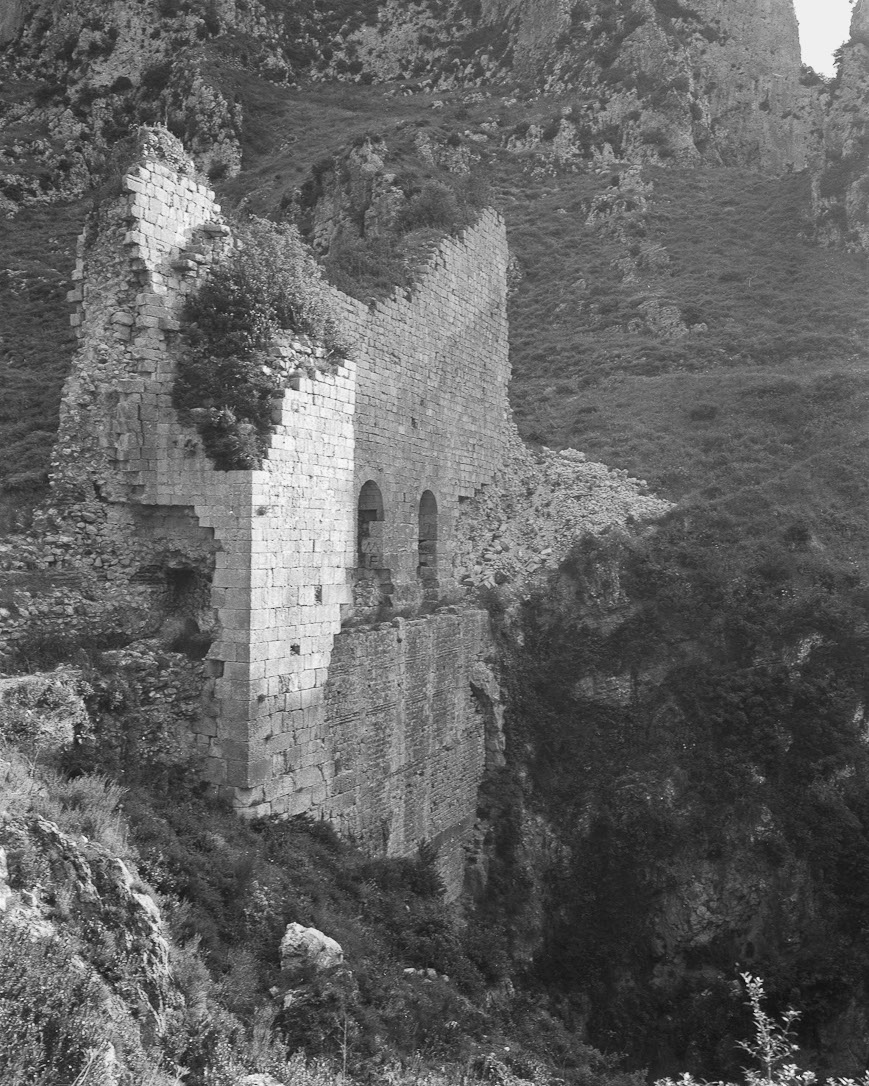
Rıfat Göbelez, Mont Habib-i Neccar, Avril 2024, issu de la série Antioche(s)
Eugenie Shinkle is drawn to rock as once-living matter transfigured into a form that appears inert, but is shaped by continuous pressure and change. As part of this exhibition, the artist presents a new, temporary installation that explores how images accumulate, fragment, and interconnect. The grid plays a central role in this process, not as a formal device, but as a way of thinking. Rather than offering interpretation, the work establishes conditions for sustained looking. It asks how attention is organised, how order arises through repetition, and how images are encountered in relation to one another over time. Meaning is created not through narrative or symbolic closure, but through processes analogous to the formation of rocks themselves: accumulation, pressure, interruption, and duration operating beyond the reach of human intention.
Eugenie Shinkle is an artist and writer based in London, UK. Her work spans photographic practice, critical writing, and editorial activity, with a sustained interest in the way that images operate as objects, systems, and sites of attention rather than as vehicles for narrative or expression.
Alongside her artistic practice, Shinkle writes extensively on contemporary photography, visual technologies, and the material life of images. Her published work addresses questions of materiality and perception, often focusing on how photographic meaning emerges through physical encounters. She is particularly concerned with forms of looking that unfold slowly, resisting immediacy, legibility, and linear time.
These concerns inform her photographic work, which frequently takes the form of multi-image configurations and installations. Rather than isolating images, she explores how meaning is generated through proximity, repetition, and variation, and how photographs behave when encountered as part of a larger visual field. Geological and organic formations provide an ongoing point of reference, not as symbolic motifs but as models for thinking about time, materiality, and organisation beyond human scale. Shinkle’s work has been exhibited internationally and is closely connected to her writing and teaching. She is also the editor of C4 Journal and contributes regularly to critical discourse on photography and visual culture.
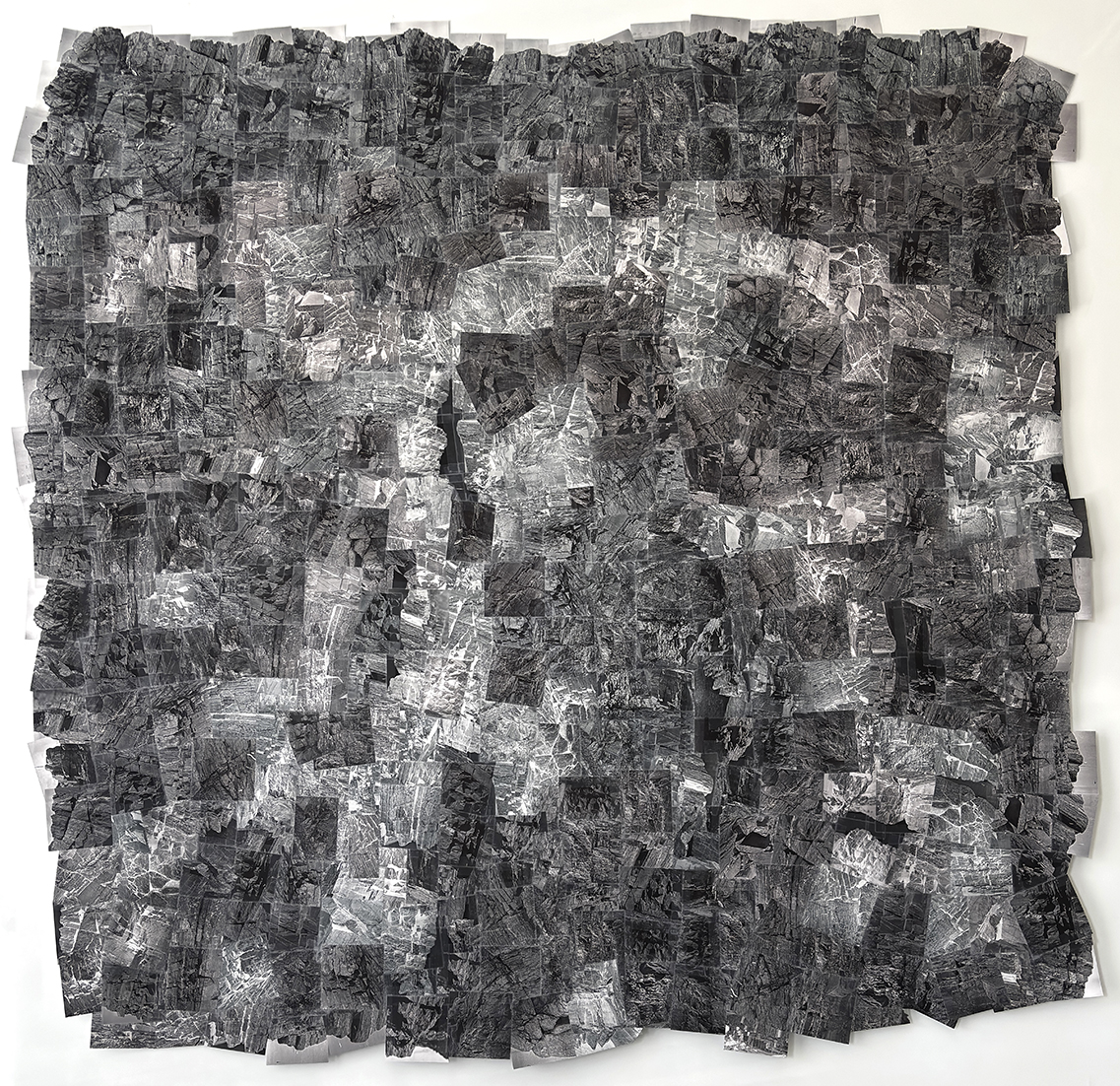
Eugenie Shinkle, Middle Cove Beach, Mulhouse Variant, 2026
On a black Plexiglas panel, the photographer arranges the shapes of seashells, capturing them in their quietest state. These shells come from a collection once assembled by an elderly man and now inherited by his son. These objects, passed down through generations, become celestial bodies that form constellations. The geometry of their curves raises questions about human and natural creations, about our place in the world and our impact on it. Drawing on the legacy of still life, Roselyne Titaud aligns her photographic work with the classical pictorial tradition.
Roselyne Titaud earned her degree in Fine Arts in 2001 and then lived and worked for several years in Saint-Étienne. She soon began exhibiting in France, notably at the MAC in Lyon, in Grenoble, and in Arles. In 2009–2010, a residency at the Akademie Schloss Solitude in Stuttgart marked a turning point: she moved to Berlin, where she would remain for fifteen years. This experience earned her recognition from, among others, the MAM in Berlin and the SK Stiftung in Cologne. Enriched by this journey, she moved to Paris in February 2025, where she immediately exhibited the Cosmologies series at the Hermès workshops (a collection of which she is a part) in Pantin.
The dissonant compositions in the series Collages for Nina combine archival images of Pompeii with family photographs taken on an iPhone. The latter depict Pauline Hisbacq’s daughter in her daily life—playing, sleeping, and exploring the world around her. The manual process of cropping, combining, and then collaging is part of a hands-on approach to image manipulation. The manual process of cropping, juxtaposing, and then collaging is part of a craft-based approach to manipulating images. The imprints of the bodies of Pompeii’s inhabitants who perished—caught in the eruption that destroyed the ancient city—are juxtaposed with the body of the photographer’s daughter, whose poses blend with them. Thus, life fills the voids left by the volcano’s blast. This formal and temporal back-and-forth enabled by collage evokes spiritual metamorphosis, the transformation of the world, brought about by the volcano and by birth. Life flows through the earth’s hollows. After death, life returns, and so it is; such is the order of things. Thus, within death, tenderness endures, and within new life, tragedy is foreshadowed. This volcano, this child, is a monster, an altar, an image, a feeling. It is the intimate and the world.
After studying philosophy, Pauline Hisbacq graduated from the ENSP in Arles. Her work, whether in photography or through the manipulation of archival images, poetically evokes youth, desires, rites of passage, and resistance. She seeks emotions in shapes and forms. She seeks out emotions in forms and figures. Today, she explores the connections between the personal and the political, myth and the contemporary. Her work has been exhibited at venues including the Frac Grand Large, the Centre Photographique Rouen Normandie, and the La Chapelle Saint Jacques art center, and has been featured in numerous publications. She is also a photographer at the Rodin Museum and an editor at September Books.
Sangyon Joo, having gained a new perspective on the act of seeing through an incident that nearly resulted in losing her eyesight, connects the blood vessels in her x-ray photos to tree branches or juxtaposes them with other objects, thus intertwining the inner and outer landscapes. The places and subject matter she beholds converge within the tapestry of memory. The photographs from this series that were selected for the exhibition are centered on the memory of water and Walden Pond. This is the very same pond that the philosopher Henry David Thoreau chose as his home in his time.
Sangyon Joo was born in Seoul, South Korea. She earned a Bachelor of Fine Arts from Seoul National University in 1994 and a Master of Fine Arts from Hongik University in 1999. She studied under Linda Connor and earned a second Master of Fine Arts from the San Francisco Art Institute. In 2010, she founded Datz Press and Datz Museum, two institutions dedicated to photography and the book. Since the beginning of her career as an artist, she has continued to exhibit her work in book form and present it at numerous international art book fairs. Recently, she published Other Ways of Being and held a solo exhibition at Datz Frame. Her works have been exhibited internationally and are part of numerous private and public collections. She is deeply committed to international intercultural artistic exchange as both an artist and an artistic director.
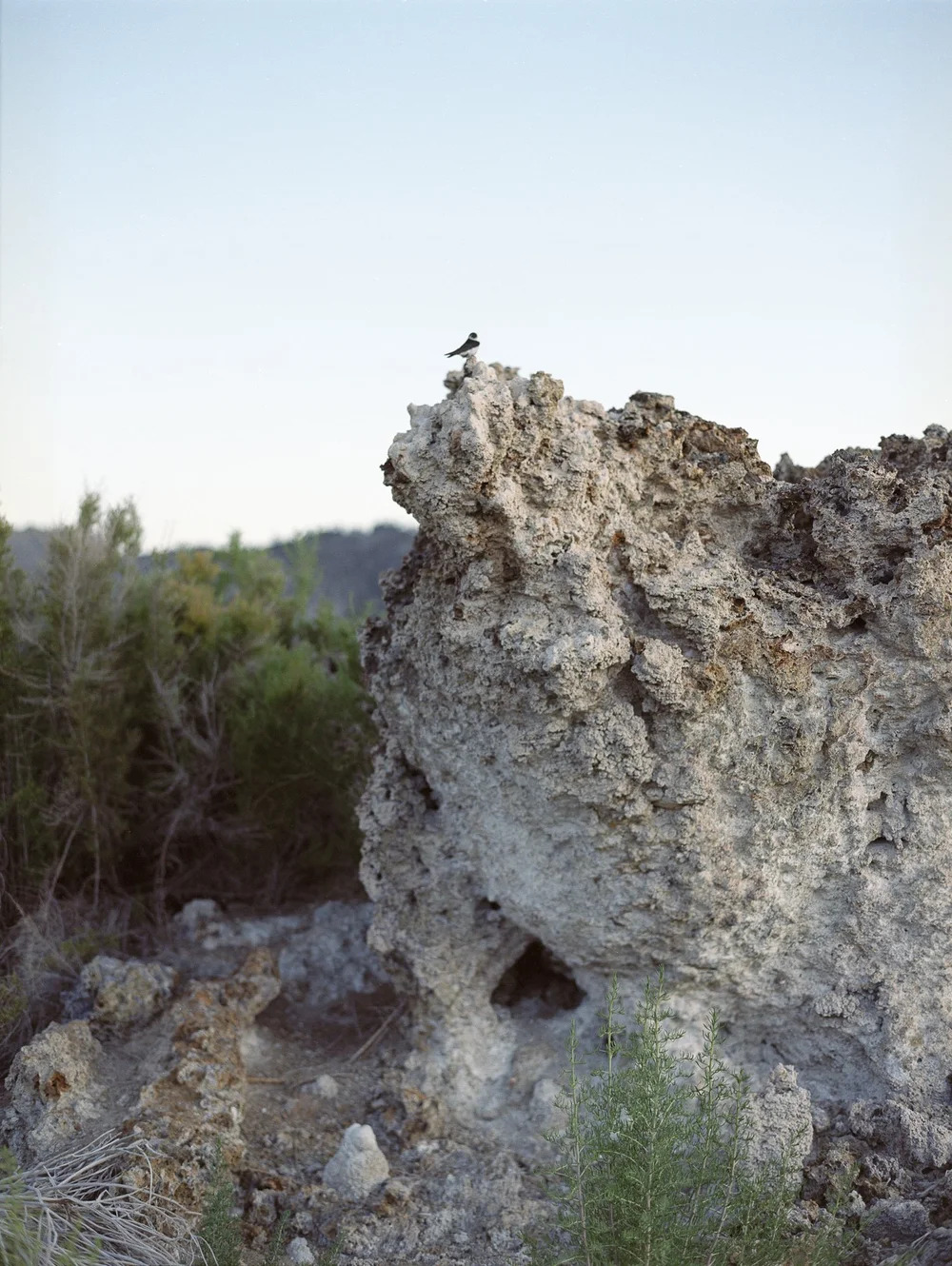
Sangyon Joo, Other Ways of Being, 2023-2025
Bernard Guillot’s work is a multi-layered index of poetic micro-narratives, immersing the viewing in a world where time itself becomes a defining force—both shaping a place and marking the passage through it. In City of the Dead, Guillot unveils fragments of a realm where ruins intertwine with remnants of life, where existence is shaped by the psychogeography of its surroundings. It is a meditation on transience—on death, on life passing by, on life worth living. For the exhibition of this series, a specific installation was created based on the book published by Origini Edizioni and on the editorial choices of its artistic director, Ilias Georgiadis.
Bernard Guillot (1950–2021), born in Basel, divided his time between France and Egypt. A painter and photographer, he graduated from the École nationale supérieure des beaux-arts in Paris. Guillot received the Prix Nadar in 2003 for his photobook Pavillon Blanc (The White House Filigranes Editions). His works are held in numerous private and public collections, including the Centre Pompidou, the Musée d’Art Moderne de Paris, the Bibliothèque nationale de France, and the American University in Cairo, among others.
The collections of the Nicéphore Niépce Museum include nearly three million photographs and objects. Much like its collections, which bring together various types of images (works by artists, amateur albums, documentary archives, etc.), the selection made for this exhibition is diverse, both in terms of the time periods it spans and the perspectives of its creators. As if they were settling to the bottom of a stream, the nearly 75 photographs from the collections of the Nicéphore Niépce Museum are gradually added to the exhibition over the course of several weeks. Scattered throughout the exhibition space, they create echoes with the images of contemporary photographers.
Photographs from:
- series by François-Joseph Chabas, Léon Collin, Robert Demachy, Maurice Deribéré, Pierre d'Espiney, Marcel (known as Célic) Henry, William Henry Jackson, Édouard Guy Loydreau, Ernest Sedallian, Underwood & Underwood, Louis Vigne, and Charles Nègre
- the Chusseau-Flaviens and Sartony agencies
- the Michalet studio and Combier Imprimeur Macon
- the collection of René Desbrosse, paleontologist
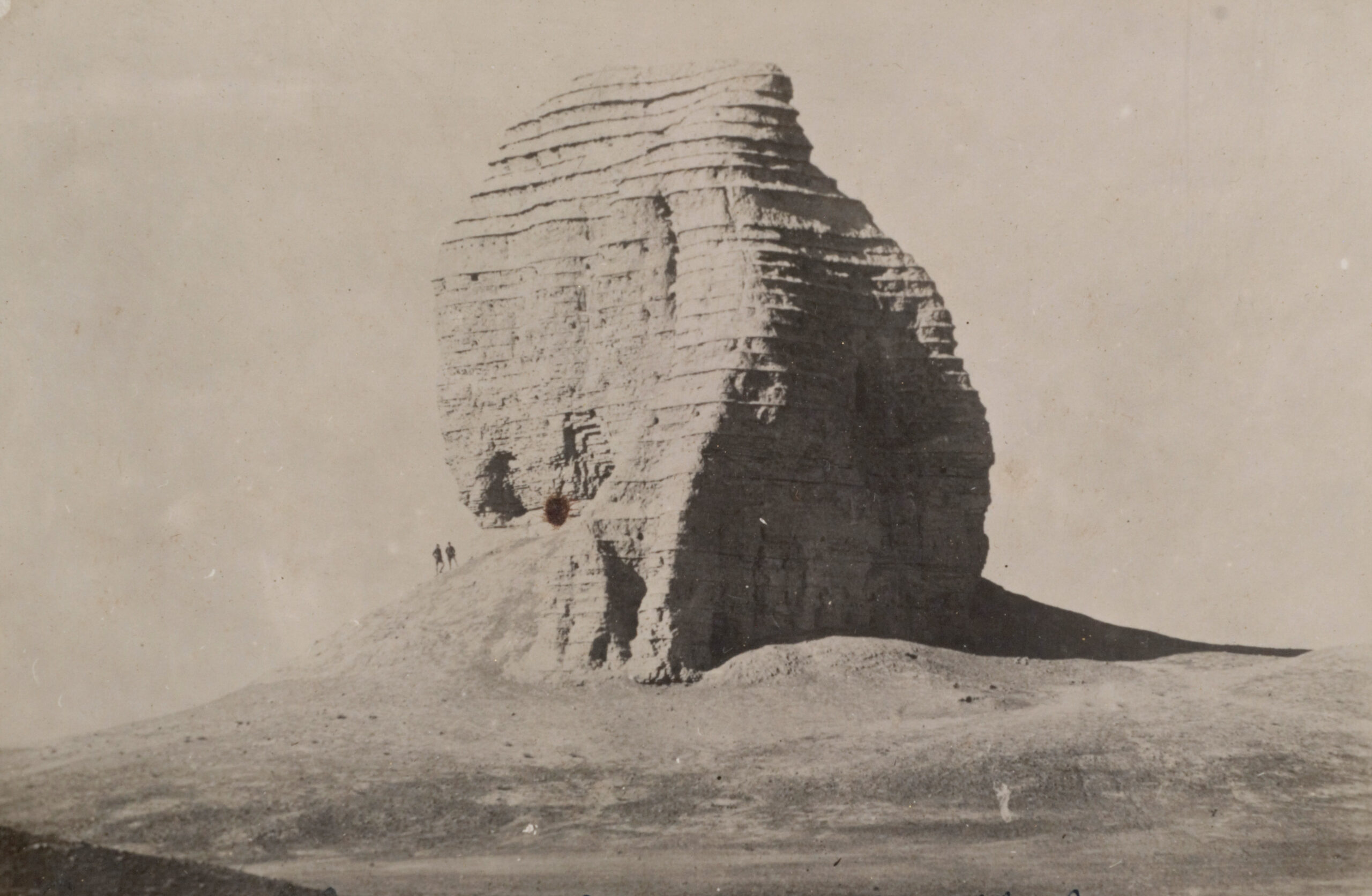
Le monolithique près de Bagdad, datant du VIè siècle avant J.C. (titre inscrit), vers 1924-1926 © Collection du Musée Nicéphore Niépce